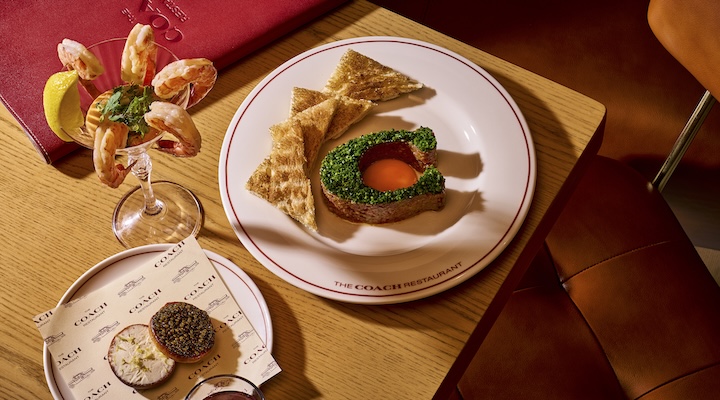
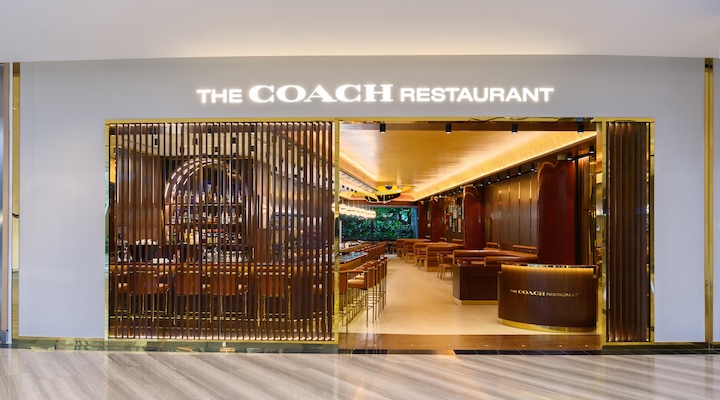


As luxury and premium brands grapple with slowing discretionary spending and increasingly selective consumers, experience has become one of the few remaining levers for differentiation. The opening of The Coach Restaurant Singapore at Jewel Changi Airport has placed the brand firmly at the centre of that shift. Set against the dramatic backdrop of Jewel’s Rain Vortex, the 56-seat modern steakhouse reimagines classic New York dining through a distinctly contemporary lens. The ful
he full-service, modern stakeshouse is layered with visual cues that reference Coach’s heritage, including glovetanned leather details used across menus, aprons and banquettes, and flatware inspired by archival collections. Even the architecture participates in storytelling; there are bronze mirror walls and terrazzo floors with tropical wood louvers that nod to Southeast Asia, while a suspended yellow taxi cab hovers overhead as an unmistakable tribute to New York City.
The restaurant completes a tightly integrated ecosystem that reflects how the brand increasingly wants customers to experience Coach – from fashion, food and culture, to products.
This strategy speaks directly to the priorities of a younger luxury consumer. Gen Z shoppers are entering the category earlier, but with different expectations. For Coach, hospitality offers a way to engage this ‘Timeless Gen Z’ cohort beyond the traditional retail transaction – increasing dwell time, repeat visits and emotional attachment, while lowering the psychological barrier to entry for first-time luxury buyers.
In a conversation with Inside Retail, Coach’s SVP and GM, Southeast Asia and Oceania, Campbell O’Shea, discussed the natural choice for this flagship, how hospitality fits into the company’s wider growth strategy and what comes next as the brand looks forward to 2026.
Inside Retail: Coach has been investing more deeply in hospitality. How has this strategy been performing so far?
Campbell O’Shea: We’re very pleased with how our hospitality concepts are resonating. Hospitality gives us the opportunity to connect with consumers through all five senses, and that’s something we’ve been intentional about. Every element of the restaurant was designed in close collaboration with our creative director, Stuart Vevers, through the lens of bringing Coach to life. From the leather banquettes and the suspended taxi to the plateware and table details, everything is inspired by our brand heritage.
What we’re seeing is that customers are spending more time with us, visiting more frequently, and genuinely enjoying the experience – whether that’s having a Coach coffee or a Coach burger. It’s been a very positive response so far.
IR: Why was Jewel Changi Airport the right location for Coach’s restaurant concept?
CO: We already have a strong retail presence here, and Jewel offered a unique opportunity to connect with both local customers and a high volume of international travellers. It’s a location where we can engage with a diverse audience, which makes it ideal for a concept like this.
IR: Coach now operates an ecosystem that includes retail stores, a coffee shop and a full-service restaurant. How do these formats work together to shape the Coach lifestyle experience?
CO: What we’re bringing to life is the Coach lifestyle. Across the restaurant, the coffee shop and our retail spaces – including Coach Bar here in Singapore – the intention is to engage consumers through multiple touchpoints that feel cohesive and complementary.
The customer journey is incredibly important to us. Here, the retail store and the restaurant are connected both physically and visually, allowing customers to move seamlessly through the brand story. You’ll see our leather craftsmanship expressed not just in our products, but also in the food experience – from sculpted butter shaped like our signature ‘C’ to burgers stamped with the Coach mark. All of this is designed to complement our core luxury leather business.
IR: Is hospitality intended to become a meaningful revenue stream, or is its primary purpose to deepen brand equity and customer lifetime value?
CO: Our approach is guided by what we call our Amplify strategy, which has four key pillars. First is building emotional connections with our consumer – really understanding who she is and meeting her where she is. Our focus consumer today is what we call the “Timeless Gen Z,” typically between 17 and 27 years old.
The second pillar is product innovation, where we lean into our 80-year heritage of quality and craftsmanship. The third is retail experience, which includes hospitality as an extension of how customers engage with the brand.
Hospitality allows us to create a lifestyle ecosystem where customers can shop with us, dine with us, and spend more meaningful time with the brand. We see it as both an experiential and commercial opportunity. Customers are staying longer, visiting more often, and that engagement ultimately supports long-term brand growth.
IR: Many fashion brands have experimented with cafés, but few have built full-service restaurants. What is Coach trying to achieve that others haven’t?
CO: It comes back to creating meaningful experiences. Our consumers are telling us they want more than a transactional relationship with brands. They want to connect in ways that feel purposeful and immersive. Hospitality is one of the ways we can deliver on that expectation as part of a broader brand strategy.
IR: Who is the core customer Coach is trying to reach through these experiences?
CO: We value all of our consumers, but strategically we’re focused on connecting closely with Gen Z. We call her our “Timeless Gen Z” – she’s entering the market, often buying her first luxury bag. Many of us remember buying our first Coach bag at a similar stage in life, and we’re re-creating that moment for a new generation.
IR: Can you share a specific initiative in Southeast Asia or Australia of which you’re particularly proud?
CO: Coachtopia is a great example. In Singapore, it’s housed in our shophouse space and serves as a platform for learning about sustainability and more responsible practices. Sustainability is deeply important to us as a brand, and it’s also a priority for Gen Z consumers.
What’s exciting is that Coachtopia is co-created with the Gen Z community. It reflects both our brand values and the passions of our customers, particularly around circularity and innovation.
IR: What are the biggest operational challenges in scaling a hospitality concept globally?
CO: Consistency is key. We’re focused on ensuring that every hospitality touchpoint reflects the same high standards as our core brand. That means delivering expressive luxury across every part of the customer journey – from service and food quality to design and storytelling – no matter the market.
IR: Do you plan to unify the digital ecosystem so customers can move seamlessly between retail, café and restaurant experiences?
CO: Absolutely. Today’s customer is fully omnichannel, and what they experience digitally needs to be reflected in physical spaces. You can already see this in how our restaurant bookings work online, and in the way our brand storytelling – from leather details to icons like Little Miss Jo from the Coach Coffee Shop – appears consistently across digital, retail and hospitality platforms.
IR: Are there more Coach restaurants in the pipeline?
CO: We’re continuing to explore opportunities across major markets, including Southeast Asia, China, Japan and North America. Hospitality is an area we’re actively investing in, and you’ll see us continue to expand thoughtfully.
IR: What criteria guide where Coach opens its next wave of experience-led stores or restaurants?
CO: We look at what we call “magic and logic.” The magic is ensuring the experience is best-in-class; the logic is choosing the right location at the right time. We prioritise places with strong local and tourist traffic, and where Gen Z consumers are already spending time – both digitally and physically. We’re always looking for creative ways to stretch what’s possible, whether that’s popups, shophouses, or playful concepts like Coach Airways.
IR: Coach has seen renewed cultural relevance through celebrity moments. How do you plan to turn that momentum into durable brand equity?
CO: We’re seeing millions of Gen Z consumers engage with the brand for the first time – and importantly, they’re coming back. That momentum is translating into tangible results. In the first quarter, we delivered 16 per cent growth and expanded profit margins, showing that brand heat is converting into sustainable growth.
IR: Looking ahead to 2026, which markets stand out for future hospitality expansion?
CO: We’re expanding significantly in North America, China, Japan and Southeast Asia. Hospitality started here in Southeast Asia, and it remains a core region for us, alongside global growth across our major markets.
IR: Has anything surprised you about how customers are using the restaurant space since opening?
CO: Honestly, a lot. What’s been especially exciting is how people are sharing the experience – photographing the food, the taxi installation, and the small details that reimagine Coach icons in a new way. Seeing friends in New York send me photos of the Coach Restaurant in Singapore tells us the concept is travelling globally, and that’s been a positive surprise.
This story first appeared in the February 2026 issue of Inside Retail Asia magazine.