
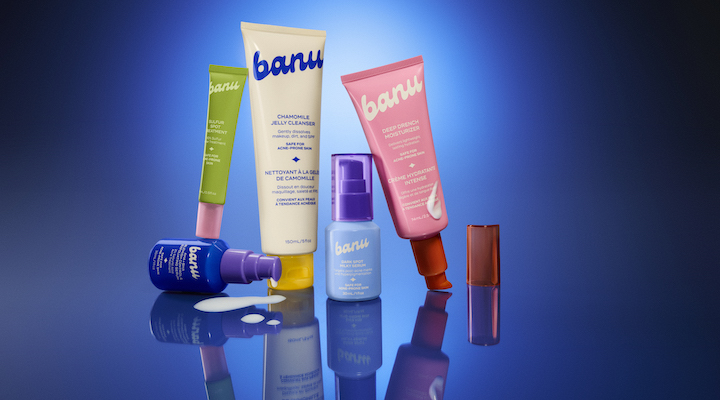
How does an up-and-coming skincare brand differentiate itself in a highly saturated market? Through a defined approach to storytelling, a distinctive aesthetic and an authentic approach to building community, answered Roz Samimi, the CEO and founder of the acne-centered skincare brand Banu Skin. With Inside Retail, Samimi discusses her lightbulb moment for launching Banu Skin, how her personal journey with acne treatment shapes how she engages with consumers, and how a brand that has yet to reac
o reach its two-year mark has already landed on Sephora’s physical and digital shelves.
Inside Retail: Prior to launching Banu Skin, can you delve into your career background and how your path led you to become a brand founder?
Roz Samimi: I don’t have a background in beauty, so what brought me into this space was really trying to solve my own problem.
I studied at UC Berkeley and spent the first part of my career across consumer insights, social impact, and tech. In hindsight, each of those experiences gave me something I now use every day as a founder.
Consumer research taught me how to understand what people want and need. Working in social impact shaped the way I think about community and building something people feel genuinely connected to. Also, working in a fast-paced tech startup gave me a front-row seat to what it looks like to build and scale a company.
Ultimately, I left a stable career because I had been struggling with chronic acne for more than a decade and couldn’t stop thinking about how differently the category could serve people like me. That conviction eventually became strong enough that I knew I had to build the solution myself.
IR: In a competitive field such as the beauty sector, what tactics or strategies does Banu Skin incorporate to stand out?
RS: Standing out starts with being extremely clear about who we are and who we’re building for.
Beauty is incredibly crowded, so I think the worst thing you can do is try to be everything to everyone. Every decision we make comes back to the acne-prone consumer and how we can better serve them.
The second piece is our visual identity. I was very intentional about making Banu look and feel completely different from traditional acne care, which can often feel clinical, sterile or juvenile. Our world is colourful, joyful and influenced by my Iranian heritage. I wanted someone to walk into Sephora, see a sea of products, and immediately recognise Banu. The goal was to build a brand that feels culturally relevant and exciting enough that you want it on your bathroom counter, not something you reluctantly buy because you have acne.
The third, and probably most important, is community. Acne is such an emotional experience, so we’ve built the brand around the full experience of living with acne-prone skin, not just treating a breakout. Our community members are called the Breakout Baddies, and we bring them into the brand through events, masterclasses, product development, education and content featuring people who actually have acne.
We’re not promising a miracle product that will give you perfect skin overnight. We talk about progress, the realities of living with acne, and the things I wish I had heard when I was struggling the most. I think that creates an emotional connection that’s difficult to manufacture.
Ultimately, our strategy is pretty simple: know exactly who you’re for, create a brand world that is unmistakably yours and give people a reason to feel like they’re part of something bigger than the products themselves.
IR: Following its launch on Sephora.com in 2025 – where the brand sold out within its first week – Banu Skin is now expanding into 23 Sephora stores across key markets including New York, Los Angeles, Miami and Las Vegas, this fall through early 2027. How did the retail partnership initially come about, and what did it take to move from digital shelves to brick-and-mortar locations?
RS: Our relationship with Sephora actually began before banu launched. In 2024, I was selected as one of eight founders for Sephora Accelerate, and because we were still pre-launch, I had the unusual opportunity to work closely with their team while we were still refining the brand, assortment, positioning and go-to-market strategy.
That relationship ultimately led to launching on Sephora.com in June 2025 alongside our own DTC site.
Like a lot of founders, I was excited to launch on Sephora.com, but being in stores was always the ultimate goal. So I asked Sephora directly what we would need to be doing on Sephora.com to earn an in-store opportunity. The number felt so far away that I thought, “Okay, this could take years.”
At a certain point, I stopped obsessing over that number and decided to focus on what I could control: building the strongest brand possible.
We spent a lot of time getting incredibly clear on who our customer is, what they care about, why Banu deserves to exist, why someone should choose us, and most importantly, how we want our customer to feel when they interact with the brand. We focused on building a distinct brand world, not just trying to sell products.
I think that clarity really resonated with Sephora. Even though we’re still a very young brand, we know who we are, who we’re for, and what we stand for. Sephora is an incredible brand builder, and I think they recognised that there was something genuinely differentiated here.
So when the opportunity came up to be featured on fully branded towers across 23 high-velocity Sephora doors, they thought of banu. It was obviously a huge milestone for us, but in some ways it felt like it came out of nowhere because I had stopped chasing the in-store milestone and was so focused on building the brand itself.
Moving into physical stores feels especially meaningful because skincare is such a tactile category. People can finally discover banu in person, experience the textures, speak with Beauty Advisors, and understand how the products work together as a routine.
We’re treating this opportunity as exactly that: an opportunity to prove what Banu can do at retail and earn the right to keep growing from there.
IR: In addition to Sephora, what other steps is Banu Skin planning to take to expand in the US retail market?
RS: Right now, our priority isn’t to be everywhere. It’s to build Banu thoughtfully and prove that we can be really successful where we are. Sephora is an incredibly important partner for us, so a major focus is continuing to deepen that relationship and demonstrating strong performance both online and in stores.
At the same time, our own direct-to-consumer business remains incredibly important because it gives us a place to educate, build community, test ideas, and have a much deeper relationship with our customer.
We’re also continuing to create more opportunities for people to experience Banu in real life through sampling, events, education, and other community activations.
Long term, I absolutely believe the opportunity is much bigger. But at this stage, I would rather build real demand and expand intentionally than chase distribution for the sake of having more doors.
IR: What goals do you hope to achieve with Banu Skin over the next year and the next five years?
RS: Over the next year, the biggest goal is to prove that Banu belongs in physical retail. We have this incredible opportunity with Sephora, and I want to show that there is meaningful demand for skincare built specifically around the needs of acne-prone consumers.
We’re also continuing to expand the product assortment very intentionally. I want someone with acne-prone skin to eventually be able to build a full routine around their needs and goals, not just reach for us when they have an active breakout.
Over the next five years, the ambition is much bigger. I want Banu to help change the way the beauty industry thinks about acne altogether.
My hope is that “acne-safe” eventually becomes a baseline consideration across skincare in the same way concepts like sensitive-skin friendly have become mainstream. Acne-prone consumers should be able to shop for hydration, SPF, brightening, barrier repair and even categories beyond traditional skincare without wondering whether they’re compromising their skin.
If Banu can help move the industry toward that standard while also building the brand people with acne-prone skin genuinely love and identify with, that would be incredibly meaningful to me.
Further reading: POV Beauty’s Ani Hadjinian discusses working with indie and legacy players


