
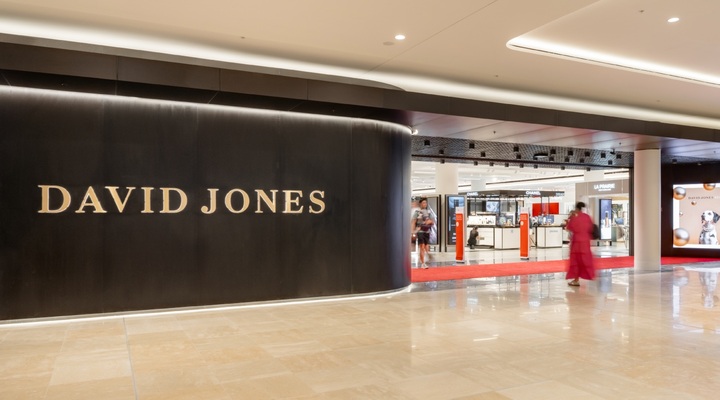
I’ve always had a soft spot for David Jones. For 188 years, it has been a cornerstone of Australian retail, and most of us have memories of walking through those doors. That’s why this week’s news was so disappointing. The Australian Financial Review reported that David Jones needed $10 million in emergency funding from its lender Hilco to secure enough stock for Christmas. The retailer had allegedly breached a lending covenant and missed payments to some concession operators, while the AF
AFR also reported that CEO Erica Berchtold was reviewing plans that could see its 38-store network cut by more than half. That comes on top of a $95.5 million pre-tax loss for the year to June 2025, when sales fell nearly nine per cent.
The easy explanation is that the retail landscape and its customers have changed. Of course they have. They always do. Retail is like playing squash. You hit the ball, return to the centre and prepare to pivot again. No three- to five-year plan survives the first rally. But Myer is on the same court, so the landscape explains nothing.
I think the writing has been on the wall for years. Put simply, David Jones has spent too long extracting from the business when it needed to be adding to it. Here’s why.
The trust left with the partners first
There was a time when David Jones led with integrity. It had principles that guided its relationships with brands. The conversation wasn’t about what it could secure in a partnership agreement or how much margin it could strip from a supplier. It was built around a simple idea: if the brands were winning in its stores, David Jones was winning too.
I saw how much that had changed when I was working with Cody Simpson on his brand Prince Neptune. David Jones recognised Cody’s appeal as an artist and the customers he could attract. It agreed to give us space and help launch the brand, but the negotiations focused heavily on what David Jones would get out of the deal.
The margins left little room for the brand, and the product never received the display space or attention needed to create a meaningful customer experience. It soon got lost on the shop floor. There’s no bitterness in saying that. David Jones was a big business under pressure, doing what businesses under pressure tend to do. But the experience taught me a lot about what makes a partnership work.
That’s what extraction looks like from inside a partnership. It’s rarely intentional. You borrow a brand’s appeal without giving it the conditions to succeed.
And the past 12 months suggest our experience wasn’t an isolated one. In August, according to the AFR, suppliers were asked to accept a 20-week repayment programme covering both outstanding payments and those falling due in the meantime. Accent Group stopped supplying David Jones in July and will now only deliver on cash-on-delivery terms.
Effie Kats, Acler, Significant Other and Aston Studios have entered exclusive department store arrangements with Myer. Country Road Group is pulling nearly 100 of its 283 concessions next year, while some suppliers have reported since March that they have been unable to obtain trade credit insurance for stock supplied to David Jones.
The lesson is clear: a department store runs on borrowed trust. Part of the reason customers believed in David Jones was that the best brands chose to be there. But when those relationships become extractive, brands withdraw their best products, people and launches. Customers feel the difference on the shop floor, even if they don’t know what’s behind it.
They don’t see the payment disputes. They simply see a store that no longer has the things that made it worth visiting.
And they’re already reacting. Some shoppers have even taken to social media to urge others to use their David Jones gift cards quickly. That says more about the state of trust than any sales report. It’s what happens when the repetition that builds a reputation starts working in reverse.
You can’t refit your way back to a feeling
To be fair to David Jones, the retailer hasn’t been sitting still. It has spent $250 million on its transformation, refurbished stores, launched an app, upgraded e-commerce and relaunched its loyalty programme. Walk through Bourke Street or Chatswood Chase and you can see where the money went.
But while it improved how customers shop, it never really answered why they should shop there.
Every brand starts as an emotional default, chosen because of the feeling attached to it. Repeated experiences reinforce that feeling and build a reputation. Over time, the reputation becomes a cognitive default. Customers no longer have to think about where to go. They just go.
Coles for groceries. JB Hi-Fi for home technology. And, for a very long time, David Jones for anything that mattered. The mistake was assuming that default was permanent and no longer needed to be earned. But it only lasts while you keep reinforcing the feeling that created it.
Once that stops, the shortcut begins to decay. Customers start thinking again, and that means comparing and questioning. David Jones then loses to Myer on breadth, to brands’ own stores on range, and to online retailers on price and convenience.
The moment a customer has to think about you again, you’ve already lost the default. That’s what resting on your laurels looks like in 2026: spending heavily on how customers shop because you assume the brand name will take care of why they should.
A points balance is not a reward
At IGU, we work from four fundamental motivations that drive customer decisions: Reward, Ideology, Coercion and Ego. When a brand is unclear on any of them, customers feel the gap long before it appears in the P&L.
I’ll focus on Reward here, because David Jones’ loyalty programme illustrates the problem particularly well.
David Jones Rewards relaunched with Qantas in September 2025. Customers earn three David Jones points or one Qantas point for every dollar spent, while Bronze, Silver and Gold tiers are determined by annual spending. At the standard earning rate, 1,500 David Jones Rewards Points are worth a $10 reward, meaning customers must spend $500 to get $10 back – a rebate of about two per cent.
Points aren’t worthless. Plenty of Qantas members will tell you that. But when a points system becomes the central proposition, it’s little more than an empty dopamine giveaway.
Why? Because it doesn’t address the feeling customers actually need.
Reward is about giving customers a sense of winning and progressing in their lives. The tiers offer a form of progression, but they’re really measuring how much customers spend with David Jones. That’s reward working backwards.
Think about a Dyson vacuum. You push it across the floor and watch dust collect in the clear bin. Even something as ordinary as vacuuming gives you a sense of progress and achievement.
The reward is built into the experience itself. Points, by contrast, arrive after the purchase and merely measure how much you’ve spent.
Dyson achieves this because it has a clear answer to a simple question: where do we go for the best-designed product? Once that question is clear, the reward almost designs itself. Every decision has a purpose.
So what question does David Jones answer today? And is it one that Myer, a brand’s own store or the phone in your hand can’t answer just as well?
If you can’t name the question, you end up with a generic answer like points, because you have nothing distinctive to express or stand for. The loyalty programme is the symptom. Not knowing the question is the problem. Finding that answer before designing a programme or a store is the work we do with every brand we partner with.
Every business has a nervous system
I talk about trust as a competitive advantage all the time. But it’s often treated as something external: reassuring customers and removing their hesitation. Trust also runs through a business internally. When a company is under pressure to extract more value, that stress travels through every part of the organisation.
Finance stretches payment terms. Buyers squeeze suppliers. A new CEO arrives, followed by a new CFO and another five-year plan. The people on the shop floor feel all of it.
In a department store, many of those people work for concession brands, including some that haven’t been paid on time. Yet they’re the very people responsible for building or losing the customer’s trust.
To me, it’s old-school thinking to focus on what can be taken out of the P&L, whether that’s headcount, margin, price or another round of discounting.
Good businesses should instead ask what they can add: a better feeling, a stronger experience and better treatment of their partners and people. The returns should then show up in revenue.
The catch is that adding value rarely comes with an immediate metric.
When I was at Nike, employees could buy shares in the company. But the real benefit wasn’t necessarily financial. Owning shares gave you skin in the game. It changed how you worked, strengthened your loyalty and trust in the business, and made you feel genuinely part of it.
Those benefits can be measured through retention, purpose and belonging. They just take longer to appear.
Google does something similar with its Career Certificates. The courses are open to people without a degree or previous experience and are offered through Coursera, which charges a subscription fee. Google has previously said it generates no revenue from the certificates and would treat certain ones as equivalent to a four-year degree when hiring for related roles.
There’s no direct revenue for Google under that arrangement, but the programme creates a pipeline of potential future talent already familiar with Google’s way of working.
The difference is that extraction pays you this quarter and sends you the bill later. Adding value costs you this quarter but pays you back in the future. That’s why businesses under pressure so often default to extraction. David Jones shows what happens when the bill arrives. The 20-week payment terms offered short-term cash-flow relief, while the business continued to face longer-term challenges, including brand departures and difficulties obtaining trade credit insurance.
Trust compounds like SEO, but it also decays quickly when you stop investing in it. Bad behaviour can accelerate that decline.
David Jones needed to persuade its owners to accept lower returns for a period so it could invest in adding value. But that conversation had to happen while the business could still afford it.
In the six months to December 2022, shortly before Anchorage took over, David Jones reported $106 million in EBITDA. In my opinion, that was the window. Now its lender sets the timeline, and lenders don’t fund patience. The time to buy patience is when you can still afford it.
Your business is closer to this than you think
It’s easy to see this as a story about one department store. But plenty of businesses are following the same pattern in their Monday morning trading meetings. Here are two things worth doing before next week.
Firstly, ask five people on your leadership team – separately – what question your brand answers, then write down their responses. If you get five different answers, your customer is getting five different brands. That’s where hesitation and doubt begin to creep into their decisions.
Secondly, take the last three decisions that improved your P&L and ask what each one took from a partner, a customer or your own people. Then ask when the bill will arrive. If you can’t answer that, I’d argue it’s already on its way.
I think David Jones will emerge from this in some form, perhaps as a smaller business with fewer stores. I genuinely hope it does. But heritage is only the memory of trust. It can’t do the work of earning that trust today. The name was never going to be enough. Trust had to keep being earned.
Nick Gray is the founder and CEO of IGU Global, a Sydney-based retail and brand strategy consultancy.
Further reading: Is David Jones really on the brink? What we know so far


