
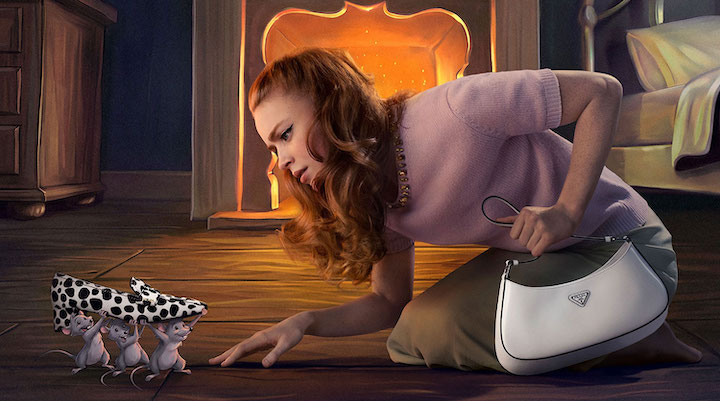
As AI-generated content increasingly dominates retail marketing, some brands are pushing back, using hand-drawn illustrations, traditional animation and other analog techniques to stand out and appeal to shoppers craving the human touch. Last October, customers went crazy over Annie Choi’s hand-drawn illustrations in the marketing materials for Gap’s collaboration with New York-based designer brand Sandy Liang. Hermès and Loewe also released hand-drawn or painted illustrations to mark major
major anniversaries this year, and now Prada is getting in on the trend.
The Italian luxury label recently released its holiday campaign, “Drawing Prada: Animated by Hand,” which, alongside leading actors including Sadie Sink, Maya Hawke, Chen Haoyu, Kelvin Harrison Jr. and Luther Ford, features hand-drawn illustrations by John Pomeroy, a legendary cinematic animator and Walt Disney veteran who helped define several iconic animated films, including Winnie the Pooh, Pocahontas and Fantasia 2000.
The campaign includes scenes of animated mice holding up a Dalmatian-print loafer to Sink, and Hawke holding a Prada handbag while talking to cartoon woodland creatures.
“As AI-generated imagery becomes increasingly accessible, it’s also becoming increasingly recognisable. There’s a certain visual sameness emerging across marketing and brands are beginning to recognise the value of creative work that feels distinctly human,” Bethany Paris Ramsay, a retail brand strategist and marketing consultant, told Inside Retail.
“Hand-drawn illustrations, traditional animation and other analog techniques offer something that algorithms can’t fully replicate: an artist’s individual perspective, imperfections, creative decisions and personal expression.”
Why consumers are responding so positively to Prada’s latest holiday campaign
In a social media post titled “Illustrations Are Having Their Moment: And Why Luxury Brands Are Suddenly Drawing Again,” marketing and brand strategy expert Anastasia Shtompel explained that when every brand can create hyper-polished content using technology, that sheen becomes less appealing.
Shtompel stated, “For years, brands made everything cleaner, smoother and more perfect. Now, what feels valuable is often the opposite: the brushstroke, the uneven line, the texture of paper and the human hand.”
As AI makes some design elements easier and faster to produce, customers may become more drawn to work that takes greater effort to create but conveys human imperfection in a tasteful and visually stimulating way.
Ramsay also noted that luxury has traditionally relied on the idea that the high prices paid by affluent and aspirational shoppers reflect the quality and craftsmanship behind the products.
By embracing painstakingly hand-drawn artwork – a process that takes considerable time and money – luxury brands reinforce their premium positioning.
“Prada’s approach reinforces the very principles luxury brands have historically built their identities around: craftsmanship, originality, and artistic excellence,” said Ramsay.
Ramsay also pointed to a broader cultural response to the speed and volume of content being produced today.
“Nostalgia certainly plays a role, but I believe the appeal goes deeper. People want to see evidence of human imagination and creative effort. There’s something meaningful about knowing an actual artist spent time drawing, painting or developing something rather than generating it through a prompt.”
How the human touch can solve luxury’s looming image issue
The growing scrutiny of luxury’s value proposition is another factor behind the attention surrounding Prada’s animated campaign, said Frankie Margotta, strategy director at consulting firm Triptk.
“Core tenets like craft, provenance, excellence, and quality have come under greater scrutiny as investigations into supply chains and production practices have exposed gaps between what some luxury brands promise and how parts of their businesses operate,” said Margotta.
Aspirational consumers have been priced out of the primary luxury market, while the secondhand market gives them access to older luxury goods – and a clearer view of differences in materials, construction and quality. Even the wealthiest customers, who have historically been central to the luxury market, are asking harder questions about what they are paying for.
Margotta explained that this puts pressure on the entire value equation. Consumers at both ends of the market are questioning not just whether a luxury product is desirable, but whether its craftsmanship, provenance and quality justify the premium.
“Anyone who knows luxury well knows that something’s gone very wrong if you’re a luxury brand that’s found itself in a cost-value comparison. Naturally, as technology makes more things easier and faster to create, and trust in some of luxury’s traditional value signals weakens, an emphasis on craft becomes incredibly powerful.”
Like Shtompel and Ramsay, Margotta argued that work made through physical or analog processes now carries a stronger human premium, helping luxury brands recapture some of the appeal they once conveyed more easily.
However, Margotta warned that brands should be careful not to draw the wrong conclusions from the popularity of campaigns such as those by Prada and Loewe.
He elaborated, “Analog creative shouldn’t become another aesthetic trend layered over the same underlying practices. If a brand is willing to invest this much time and craft into how it presents itself, consumers should be able to feel that commitment elsewhere too.”
“The real value will come when that emphasis carries all the way through the product, process and experience,” concluded Margotta.
Further reading: From Madewell to Coach: Why retailers are tapping into reading-themed launches


