
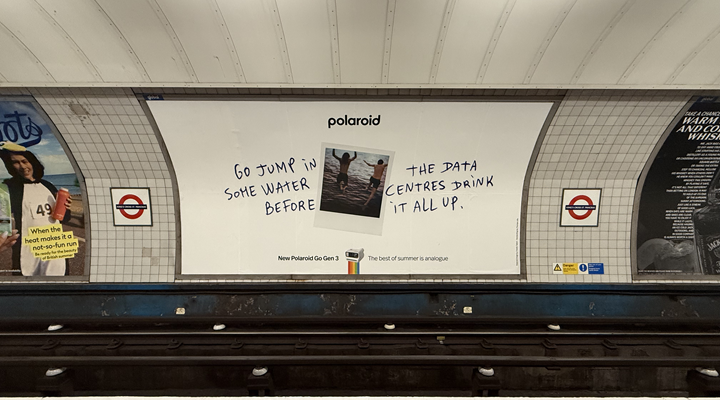
Polaroid may have just turned the AI boom into advertising’s strongest case for human creativity. Its latest campaign erected giant billboards across New York, London and South Korea, urging people to “go jump in some water before the data centres drink it all up”. The slogan, accompanied by reminders that “AI can’t generate sand between your toes” and “You can’t bask in blue light”, extends beyond just the dilemma of artificial intelligence and draws attention to the growing e
ng environmental footprint of the infrastructure powering it.
The analogue photography company, which created the first instant camera, joins a cohort of retailers, including Aerie, Dove and Cadbury, each placing an unusual emphasis on human authorship as a commercial virtue at a time when consumers are questioning what and who they are looking at.
All about presence
The campaign is consistent with a US-born brand that has, since its inception in 1937, always occupied a different corner of the photography market. On top of its obvious anti-AI and subsequent data centre stance, Polaroid continues to champion the beauty of the physical, rather than the ever-expanding archive of photos on a smartphone, asking consumers to slow down and consider the value of a single moment. “[The campaign] was an intentionally smart provocation,” Jimmy Wong, marketing manager at Polaroid APAC, told Inside Retail. “We wanted to grab people’s attention and get them to reconsider their relationship with technology as a whole…Focus on what they could lose if they don’t focus on the best parts of being human.” He explained the campaign deliberately pushed boundaries in the hope that people might “put down their phone, step outside, spend time with friends and capture a real moment on a Polaroid camera.”
The campaign also enters a debate that extends well beyond advertising. Its warning of data centres draining the earth’s water supply uses gentle mischief to draw attention to the hidden appetite of artificial intelligence. The International Energy Agency estimates that global electricity demand from data centres will more than double by 2030, while a single large facility can require up to 2 million litres of water per day for cooling. An ABC News investigation found that Australia, particularly, has become a global hotspot for data centre investment as national demand for AI accelerates. The cloud, it seems, has acquired a very tangible footprint, and retailers are finding themselves drawn into the conversation.
Paul Harrison, director of Deakin University’s Master of Business Administration Program, observes that brands and media phenomena clearly show where they stand on AI. He points to advertisements from Heineken, Cadbury, and, of course, Polaroid, which glorify their human-made makeup. “In these advertising campaigns on TV, billboards on New York streets and on social media, the companies are signalling something larger,” he wrote in The Conversation. “Even Apple’s new series release, Pluribus, includes the phrase ‘Made by Humans’ in the closing credits.” He added that these gestures suggest creativity has entered unfamiliar territory, where machines can now produce much of what we see, hear and, on occasion, even mistake for something deeply human.
Retailers are discovering that authenticity sells
Last year, Cadbury proudly announced its latest Dairy Milk campaign was filmed using real chocolate, without CGI or artificial intelligence, while in 2024 Dove became the first global beauty brand to pledge it would never use AI to create or distort images of women in its advertising. American Eagle’s Aerie went further still last October, promising never to use AI-generated bodies or people, a commitment that coincided with a 23 per cent increase in fourth-quarter sales. The common thread is that retailers are finding that how a campaign is made can be just as important as how a product is made, a proposition supported by Gartner research, which reported that 68 per cent of consumers regularly question whether the content they encounter online is actually authentic.
For decades, retailers have relied on trust markers to justify a premium. “Australian Made”, “organic”, “fair trade” and “handcrafted” all promised consumers ethical spending. Wong believes that proposition will only become more compelling. “The more of our lives that become online, the more we value the things that feel real – creativity, connection, imperfection and human experiences that can’t be replicated,” he said.
For Harrison, the implications extend beyond a collective of single advertising campaigns. “Creative work has never been only about generating content. It is a way for people to express emotion, experience, memory, dissent and interpretation.” Whether “Made by Humans” proves a passing slogan or an enduring commercial advantage, retailers have found an unexpected luxury in an age of algorithms, and optimistically, it’s evidence that somebody cared enough to make it.