
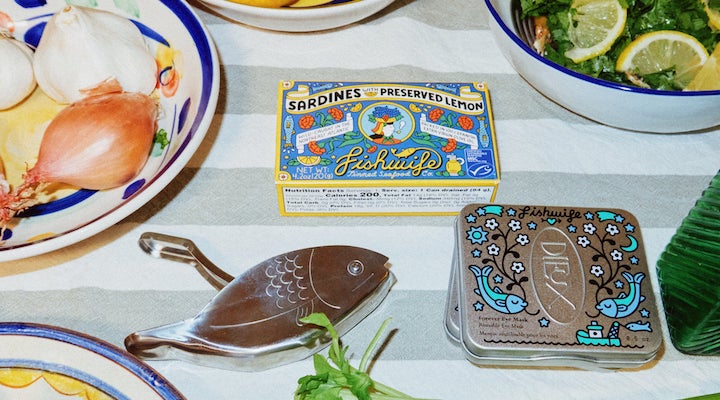
A beauty brand and a canned fish company have put sardines on a pair of reusable eye masks. It sounds like the punchline to a joke about brand collaborations, but Dieux Skin and Fishwife see a shared sensibility behind the pairing. The limited-edition version of Dieux’s Good Taste Forever Eye Mask uses the same medical-grade silicone as the original but features artwork by Fishwife’s in-house illustrator, Danny Miller. The product retails for US$25. Neither brand is new to collaborations. Di
ons. Dieux has worked with fashion brand Eckhaus Latta and fast-food chain Sweetgreen, while Fishwife has partnered with food brand Fly by Jing. Still, Dieux and Fishwife may be their least obvious pairing yet.
Inside Retail asked retail and brand strategy experts what makes a collaboration work – and what makes one fall flat.
Experts on the Dieux Skin x Fishwife collaboration
In a LinkedIn post, Turandot Yuan, a creative strategist at online database and search engine Giphy, asked, “Can tinned fish skincare become part of your nighttime routine?”
Provided the product doesn’t actually smell like sardines, her answer was yes. Yuan pointed to other beauty and food or beverage partnerships, including Elf x Liquid Death and Burt’s Bees x Hidden Valley Ranch. Such “stunt-y” collaborations can make headlines, she said, but they can also build brands when the partners share values and an audience.
“Fishwife and Dieux make sense because they share a dream customer: a woman with taste,” said Yuan. “And this is one tasteful collab that nods to their skincare ethos of aging gracefully, inside and out.”
Frankie Margotta, strategy director at consulting firm Triptk, also welcomed the creativity these partnerships can bring to retail. “I applaud brands for experimenting, taking risks and finding new ways to bring people into their worlds,” said Margotta. “Collaborations are great opportunities to merge audiences, ideas and IP to create something new or express an existing brand in a way people haven’t seen before. We need them.”
But as collaborations proliferate, Margotta sees a risk that brands will mistake combination for collaboration. “Putting two popular things together may generate attention, but attention alone doesn’t make the moment meaningful,” he said. “Hype can create a spike because one or more brands are in the zeitgeist, and heritage can bring enormous recognition, but neither really answers why those two worlds should come together in the first place, or in this particular moment, in this particular way.”
In his view, the best collaborations begin with a compelling idea. Each brand brings something the other could not create alone, whether the pairing is complementary or unexpected. The result should tell a story and show evidence that the brands have created something together, rather than simply put two logos on a product.
Margotta does not find Dieux x Fishwife particularly profound, but he thinks it offers consumers something creative and fun. “Whether someone thinks the result is clever or ridiculous is subjective,” he said. “What matters strategically is that you can explain why the two brands are in the room together. That’s ultimately what separates collaboration from combination.”
The strongest partnerships, he argued, make something neither brand would have made independently. They also introduce each brand to new consumers without becoming a substitute for the brand itself. In this case, Fishwife’s contribution is artwork on a Dieux product that already exists – a relatively modest change, even if the result appeals to both brands’ customers.
Have retail collaborations reached saturation point?
Retail brand strategist and marketing consultant Bethany Paris Ramsay thinks there is still room for them, provided the pairing offers more than surprise. “Have we reached an oversaturation point for retail collabs?” she said. “Maybe for the ones where you’d never guess these two brands would work together is the entire idea. Surprise can earn a first look, but it can’t do all the work. A successful collaboration gives people a reason to want the product and a reason to believe these brands would be in each other’s worlds. Dieux and Fishwife have both. That kind of connection might be less obvious on a category chart, but it makes sense in the reality of consumer behaviour in 2026.”
A Dieux customer might also keep Fishwife tins in their pantry, Ramsay suggested. Shoppers do not necessarily organise their tastes by retail category. Someone drawn to a brand’s design, values and sense of humour may follow it across beauty, food and fashion. That, she argued, makes the Dieux x Fishwife pairing more cohesive than it first appears.
“For me, the test is whether both brands contributed something recognisable and whether the finished product would feel less interesting without either one of them,” Ramsay said. “You should be able to see the creative exchange in the product itself, not just in two logos on a campaign image. It also helps when the collaboration offers each audience a natural way into the other brand. Curiosity might bring someone to the launch, but the product and the story have to give them a reason to stay.”
The sardines make the connection between Dieux and Fishwife visible. Whether they give customers enough reason to buy the masks is the harder test.
Further reading: Unconventional luxury brand collaborations are everywhere. Here’s why