
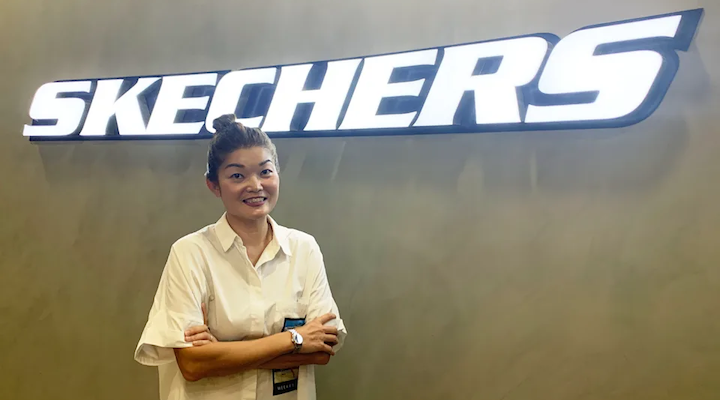
Skechers had less than 10 stores in Southeast Asia when Zann Lee joined the company in 2009. It now counts more than 1000 points of sale across the region. In a conversation with Inside Retail, Lee talked about what gets harder at that size and what the company’s bigger stores are teaching it. Inside Retail: What has changed most about the consumer since you joined the company? Zann Lee: The biggest change is that consumers today are much more sophisticated and demanding. When I first joined S
ined Skechers, consumers were often focused on the basics. Comfort was a very clear reason for consumers to choose us.
Consumers now have much more information at their fingertips. They compare prices across online and offline channels, follow global trends, read reviews, and have higher expectations of what a footwear brand should deliver. Comfort is still important, but they also expect performance, style, and products that fit naturally into their lifestyle.
That’s changed how we run the business, from what we develop to how we market it to what the store feels like. It’s not enough to know what people want to buy. We have to understand how they live and what’s influencing them.
We are also seeing younger consumers discover Skechers in different ways today. It may be through sport, entertainment, cultural partnerships, or through the communities and experiences we create around the brand.
IR: What gets harder at a larger scale, especially when the markets are so different?
ZL: At a 1000-store scale, the challenge is about making sure each location has a clear purpose and delivers an experience that is relevant to its market.
Southeast Asia is very diverse, so what works in Singapore may not work in Malaysia, Thailand or Vietnam. We need to understand the local consumer, the surrounding community and how people shop, while maintaining the consistency of the Skechers brand.
The other thing that gets harder is speed. The bigger an organisation gets, the easier it is for decisions to slow down. That’s why we give our local leadership teams the room to make calls quickly. They’re closest to the consumer, they know their markets, and that’s how we stay agile and keep our speed to market.
It also means thinking harder about the location, the format and the experience, rather than just the number of stores. The Sunway Pyramid location is a good example. We designed it to carry a wider range of lifestyle and performance products in a more immersive space.
IR: You have kept investing in larger, more experiential stores. What do these formats teach you that a conventional store can’t?
Zann Lee: The big thing is that a large store can be much more than somewhere to shop. It works almost like a learning lab. A conventional store is largely focused on product and purchase.
At Sunway Pyramid, for example, features such as SafeSize foot scanning and the DIY Customisation Corner make the shopping journey more interactive and personalised. The upcoming Coalfields store in Malaysia, meanwhile, will feature an indoor pickleball court and yoga room, allowing us to bring sport and community into the retail environment.
The Sunway Pyramid opening, featuring Seventeen’s DK, Seungkwan and Dino, is another example of how retail can come together with entertainment and culture to create a stronger connection with consumers.
Together, these larger formats give us a better understanding of what consumers are looking for from a modern retail experience.
IR: What are customers actually doing differently in these experiential stores compared with traditional Skechers stores, and how does that affect the way you think about store design and merchandising?
ZL: The biggest difference is that consumers are exploring the brand based on their interests, and we see them spending more time interacting with visual merchandising and feature displays.
Someone may come in because they are interested in running or pickleball, and then discover another category, technology, or product that they had not previously associated with Skechers. That gives us an opportunity to introduce more of what we offer in a natural way.
This is changing how we think about store design and merchandising. We are putting more emphasis on customer flow, storytelling, and creating moments of discovery. We also want footwear, apparel, and accessories to work together so consumers can easily see how the different parts of our offering fit into their lifestyle.
At the same time, the physical experience remains very important. Consumers still want to see, touch, and try products, and that is something physical retail can offer in a way that online shopping cannot.
IR: Are there particular markets or consumer segments where you think Skechers is still underdeveloped?
ZL: There is still significant room for Skechers to grow across Southeast Asia. Singapore, Malaysia, Thailand and Vietnam continue to offer strong opportunities, while there is also potential to reach consumers beyond the more established locations.
We also see particularly strong opportunities among younger and increasingly active consumers. Categories such as running, pickleball, and golf give us new ways to connect with these audiences and build credibility within their communities.
IR: How do you judge whether an experiential store or celebrity-led launch has been commercially successful?
ZL: Sales are important, but they are only one measure of success. We also look at whether we are bringing new consumers into the brand, how they engage with us and whether that engagement continues beyond the initial experience.
But the longer-term objective is to turn that initial awareness and excitement into an ongoing relationship with the consumer. The real value comes when an experience gives consumers a reason to discover the brand, come back, and engage with it again.
IR: Looking at the next three to five years, what needs to change in Skechers’ Southeast Asian business for the company to continue growing at its current scale?
ZL: The next phase is about growing Skechers beyond simply opening more stores. Retail will continue to evolve. Our stores need to become platforms for experience, discovery, and community, while being closely connected to e-commerce and digital. The journey should feel seamless, whether someone starts with us online and moves into the store, or discovers something in-store and continues their journey online.
We will continue developing larger, more experiential stores while expanding our presence in performance categories such as running and pickleball.
Younger consumers will also be increasingly important. Partnerships across sport, entertainment and culture give us opportunities to stay relevant to them.
IR: What is something about running a retail business in this region that you understand much better today than you did when you first joined the company?
ZL: One thing I have learned over the years is that a successful store is not just about the four walls around it. You really have to understand the community around the location – who the consumers are, what they are interested in, what sports they participate in, and what brings people to that area. Even when you are operating a global brand, retail in Southeast Asia is still very much a local business.
When I first joined, expansion was largely about opening stores, growing distribution, and building scale. Over time, I have learned that scale alone does not guarantee success. What matters is how well you understand the local consumer. Purchasing power, cultural preferences, shopping behaviour and even how people respond to promotions can vary significantly from one market to another.
That is why we cannot manage every market from a regional office. We need strong local teams who understand their markets and are close to the people they serve. They are often in the best position to make the right decisions quickly.
For me, the biggest lesson has been finding the right balance between global direction and local relevance, consistency and flexibility, and growth and profitability. The closer you stay to your consumers and your people on the ground, the better your decisions become.
Further reading: Skechers’ Cedrick Tan on the brand’s new growth strategy in Asia.


