Brotherwolf’s Clarendon Street studio in South Melbourne marks a confident new chapter for the Melbourne-born barbershop-fashion brand, bringing together 10 years of grooming, apparel and community-building in what founder Pádraig Whelehan calls its “most refined expression” yet. It is not a departure from Greville Street, St Kilda or Fitzroy, but a deliberate distillation of everything the business has learned about space, service and style since opening its first shop in 2014. It serves
ves as a timely example of how a specialty retailer can leverage store design, a clear brand vision and a connected tech ecosystem to remain indispensable in a frequently unpredictable retail market.
A decade of cult grooming and quiet luxury
When Brotherwolf opened on Greville Street in 2014, the move was instinctive and driven by feel rather than strategy decks. The goal then was to prove the concept and build a community around barbering, culture and a growing apparel offer, in a neighbourhood that felt like the right fit. A decade on, he described South Melbourne as a full-circle moment: less about proving the idea, more about expressing it with confidence after years of learning, refining and listening. “This next chapter is more deliberate. It represents confidence in who we are after 10 years of learning, refining and listening,” Whelehan said. The Clarendon Street store is positioned as the culmination of that journey, signalling a brand that knows whom it serves and how it wants those customers to feel from the moment they step inside.
That shift from instinct to intention is evident in the way Brotherwolf now thinks about physical retail. Early stores laid the cultural and operational foundations; this latest opening is about sharpening the edges without losing the soul. For a brand that has grown organically into a full-scale lifestyle business, the South Melbourne site becomes both a milestone and a blueprint for future expansion.
Reimagining a heritage shell for modern style
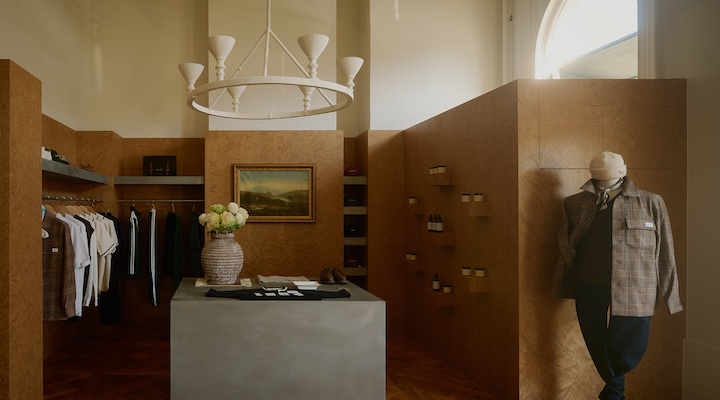
Housed in a 19th‑century former bank, the 100‑square metre Clarendon Street space could easily have become a design statement first and a retail environment second. The starting point for Whelehan and long-time collaborator Jessica Ellis of Jessica Ellis Studio was, in his words, “respect for the building. You can’t fight a space like that. You have to work with it.” The Boom‑era façade opens into a warm, finely tuned interior, where geometric parquet de Versailles flooring runs under timber‑clad walls and antique oil paintings in gilt frames, all softened by sconces and natural light from soaring skylights.
For Whelehan, the first feeling on entry had to be what he calls “calm confidence. Not intimidating, not loud, but assured.” The design leans into restraint, material honesty and pace, creating a grounded, intentional environment where nothing shouts for attention yet everything feels considered. The front of the studio is dedicated to men’s grooming, with custom-built stations, while towards the rear the retail zone unfolds with garments suspended on sleek racks and the brand’s No.113 haircare line displayed opposite, with an original bank vault repurposed as a hair-washing station and atmospheric focal point. The result is a hybrid space that feels modern without erasing its past.
Grooming and garments in one narrative
Brotherwolf’s proposition has always fused barbering, fashion and culture in a single experience, a mix that can easily feel disjointed if not handled with clarity. For Whelehan, “it starts with hierarchy. Barbering is the heartbeat. Everything else supports it.” Fashion is not treated as a separate store within the store, but as an extension of the same mindset, expressed through materials, tones and layouts that all speak the same visual language. That shared language extends from the chairs and mirrors through to the racks and shelving, ensuring the customer journey never feels like crossing from one brand into another.
Flow is a major consideration. “We also think a lot about flow. How someone moves from chair to mirror, from mirror to rack, from rack to conversation,” Whelehan explained. If those transitions feel natural, the overall experience feels unified rather than patched together. The apparel line itself grew out of that barbershop culture: What began as a handful of tees and caps for friends and regulars has grown into an internationally followed fashion line of monochrome, texture‑heavy pieces. These include wide‑leg trousers, heavyweight knits, Cuban-collar shirts and outerwear with subtle vintage references, designed to age well and fit seamlessly into Melbourne’s mode of dressing.
“Originally, people came for a haircut and left with a tee. Now, some come specifically for the clothing and book grooming later,” he shared, adding that “what connects both worlds is identity.”
Turning walk‑ins into a style‑led community
In an era when grooming appointments can be booked in seconds and apparel purchased in a few taps, Whelehan sees the role of bricks‑and‑mortar in 2026 as offering what digital cannot: “human connection, trust and memory.” “In 2026, a store isn’t just a point of sale. It’s a point of belief. People come to feel part of something, not just to transact,” he said. That belief is built through spaces that encourage interaction, linger time and storytelling, whether a customer is in the chair, browsing a rail or chatting with staff post‑appointment.
Whelehan’s measure of success is emotional recall: If someone leaves remembering how they felt rather than the specific SKU they purchased, the store has done its job. South Melbourne customers reflect the brand’s evolution here, too. Many once came for a haircut and left with a T‑shirt almost incidentally; now some arrive specifically for clothing and add grooming to their experience later. “Our customer has matured alongside us,” Whelehan stated. “People want consistency in how they present themselves, and grooming and clothing are just two expressions of the same mindset.” What connects both sides of the business is identity, with customers seeking consistency in how they present themselves and treating grooming and clothing as two expressions of the same mindset.
Moments that build a loyal neighbourhood following
Clarendon Street has been conceived as more than a daily trade space. Whelehan and the team use the studio as a platform for intimate launches, creative collaborations, talks, music sessions and small‑scale cultural moments that feel personal rather than overtly promotional. The aim is to keep the space feeling alive outside standard appointment rhythms, giving room to talent, ideas and conversations that align with how Brotherwolf ‘thinks and moves’.
From a retail perspective, these activations are designed to shape the customer journey from first encounter to long‑term advocacy. “These activations turn curiosity into connection,” Whelehan explained. “Someone might walk in out of interest, attend an event, meet the team, and suddenly feel invested. That’s when they stop being a customer and start being part of the brand.” Those relationships, he argued, create a depth of loyalty that no ad spend can replicate.
The discreet systems behind a human-centric brand
Behind the scenes, the Brotherwolf operation runs on a relatively lean but focused tech stack. The team uses booking platform Fresh for grooming appointments and Shopify to power the retail and e‑commerce side of the business, allowing team members to manage bookings, sales and analytics across multiple locations while maintaining a personalised experience. Technology, in Whelehan’s view, is there to support, not replace, the human side of the brand.
Those systems help the team understand patterns – who their customers are, how often they visit, what they respond to and where friction appears – without overwhelming frontline instincts. Data sharpens intuition rather than dictating it, providing clarity on which products resonate, how grooming habits link to retail behaviour and where the experience can be refined. That connectivity reinforces the sense that Brotherwolf is not fragmented into separate channels, but is one coherent world with multiple entry points. “While data sharpens our instincts, decisions are still led by feel and feedback on the floor,” Whelehan added.
Intertwining design, tech and community
When asked how technology, design and community activations might evolve together over the next few years, Whelehan sees the three becoming even more intertwined. “Design will continue to set the tone, technology will quietly enhance the experience, and community will remain the reason people come back,” he said. The goal is straightforward even as the retail landscape becomes more complex: “Build spaces and systems that feel timeless, relevant, and deeply human, no matter how the landscape changes.”
For a brand that began as an barbershop on Greville Street and now occupies a reimagined 19th‑century bank on Clarendon Street, Brotherwolf’s next decade will likely be defined by that balance of polish and soul – and by its ongoing belief that retail is at its best when it becomes a place people genuinely want to belong.