
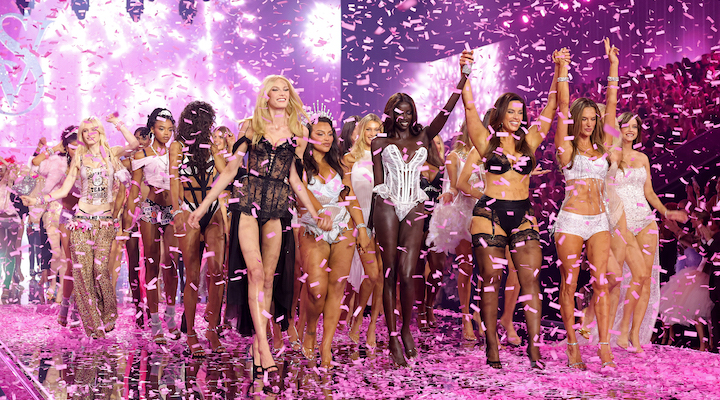
Victoria’s Secret’s latest Fashion Show – the third since its revival – delivered the A-listers and glamour on Sunday. But this time, it was set against a backdrop of improving sales and growing investor confidence, rather than lingering questions about its relevance and whether the brand is still “toxic”. The event featured performances from Megan Thee Stallion and Tate McRae, while Kylie Jenner made her runway debut in the iconic Fantasy Bra. Created in partnership with luxury jewe
eweller Jacob & Co, the bra, estimated to be worth $50 million, returned to the runway for the first time since 2018.
Shares of Victoria’s Secret closed 3.02 per cent higher on Monday. The positive response follows several quarters of steady growth and a stronger annual outlook for Victoria’s Secret, which recently raised its full-year sales forecast to between US$7.10 billion and US$7.18 billion, up from US$7.03 billion to US$7.13 billion.
Neil Saunders, managing director at GlobalData, said the results demonstrated the strength of the company’s recovery. “The strong numbers coming from Victoria’s Secret speak for themselves. After a long period of being in the wilderness, this is now a brand that is firmly in recovery and building mode.”
How Victoria’s Secret got its groove back
Saunders attributed the comeback to several factors, particularly a renewed focus on consumers and their needs. Through new product launches and a refreshed marketing strategy, Victoria’s Secret has sought to demonstrate that it understands what today’s shoppers want.
That might sound obvious, but Saunders argued that losing sight of customers was precisely what caused the brand’s prolonged downturn. “On top of focusing on products, Victoria’s Secret has also rebuilt marketing campaigns so that they are aligned with the stories the products need to tell,” he said. “Again, this is a marked change from the previous disjointed and inconsistent approach to marketing communications.”
Has Victoria’s Secret reclaimed its top-dog status?
For Frankie Margotta, strategy director at consulting firm Triptk, the answer is a resounding yes. “The numbers don’t lie. [CEO] Hillary Super has, thus far, made good on her intentions,” Margotta said.
Rather than another attempt to recapture the brand’s heyday, Margotta viewed the latest fashion show as a statement of renewed confidence. “The latest Victoria’s Secret Fashion Show felt like a commitment to reestablishing the brand’s place and point of view across female fashion, intimates and beauty, and its role as an authority and trusted curator within that world,” Margotta told Inside Retail. “It recontextualised iconic Victoria’s Secret codes and ethos for contemporary culture while bringing together a much broader range of personalities, ages, and backgrounds.”
The mix of established and new faces helped bring different generations together. Some appearances, such as Adriana Lima’s, were expected, while others, particularly Jenner’s, proved more surprising and divisive.
But Margotta argued that a divided response was not necessarily a problem. “Mixed reactions aren’t necessarily a bad thing. People felt strongly enough to love parts of the show and to dislike others. For a brand, indifference is a much worse place to be,” Margotta said. “Ultimately, Victoria’s Secret showed that it can appeal across generations while retaining the edge, fashion sensibility and cultural savvy that allow younger consumers to see themselves in the brand again and, perhaps more importantly, that now want to see themselves in it.”
Having reestablished a successful branding blueprint, Victoria’s Secret must now find ways to sustain and build on it. “Staying close to cultural moments will be important for building cachet and relevance, and there are plenty of interesting and still unexplored ways for the brand to do that,” Margotta said. “But those moments have to make sense within the Victoria’s Secret world and connect back to the underlying story. The brand has spent the last two years making that world desirable again. The next challenge is continuing to give people reasons to want to be part of it.”
Can Victoria’s Secret maintain its momentum over the holidays?
Barney Stacher, CEO of consultancy Retail OCD, was also optimistic about the brand’s prospects. But he cautioned that the excitement surrounding the fashion show would not be enough to sustain sales. “Victoria’s Secret knows how to make an entrance,” Stacher said. “Under CEO Hillary Super, the more consequential question is whether it is giving customers enough reasons to return. My reading is that the opportunity lies in making its distinctive identity feel desirable and relevant again. Glamour, fantasy and sex appeal remain valuable assets. They become commercially stronger when customers feel invited into that world and find products that work for them once they arrive.”
Although publications such as Elle have responded positively to the show, Stacher highlighted a potential disconnect between the brand’s runway image and the customer experience, particularly around sizing and fit. Closing that gap between desire and delivery, he argued, would be critical.
“Being represented on the runway and being accommodated in the fitting room should feel like parts of the same promise. Inclusivity needs an inventory position,” Stacher said. He credited Super with sharpening the brand’s identity but cautioned against confusing renewed attention with a lasting retail recovery. “I would give Super credit for the clearer expression of what the brand can stand for. However, I would separate renewed cultural relevance from a fully secured retail position. Attention creates an opening. Consistent product, fit, service and value determine how much business comes through it.”
Further reading: Why Victoria’s Secret’s sales miss spooked investors


