
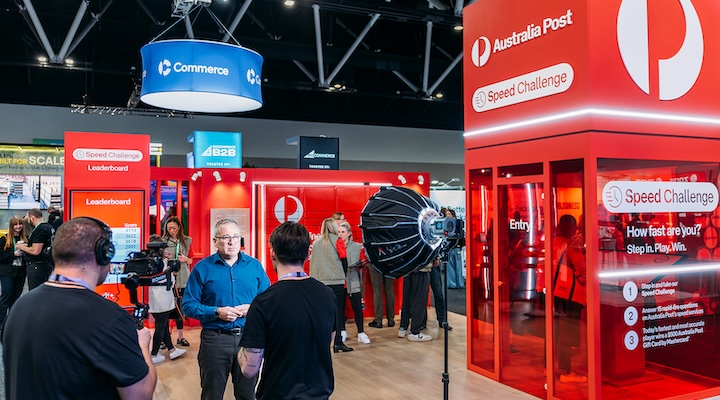
There has never been a better time to be an Australian shopper, but it may also be the toughest time in decades to be an Australian retailer. That was the central paradox in the opening keynote at the 2026 Online Retailer Conference, where Australia Post’s executive GM of parcel, post and e-commerce services, Gary Starr, set out a roadmap for retailers trying to keep up with rapidly rising expectations.
Starr argued that local businesses do not need to become global marketplaces to compete with them; instead, they can win by plugging into the right ecosystem and doubling down on what makes them uniquely local.
Competing without becoming a marketplace
Australians are spending more online, buying more often and hunting around for the best value and best deals as they pop up. Shoppers now expect fast delivery, high transparency and flexible options because they have seen what is possible from the world’s largest online players. Starr noted that four out of 10 online transactions in Australia are now through online marketplaces, which are increasingly setting the expectations customers bring to every online shopping experience. In that context, he framed the challenge for local players not as a race to build everything themselves, but as a question of how to sustainably compete on experience.
Starr’s answer is to stop thinking like a standalone operator and start thinking like part of an ecosystem. He told delegates that retailers do not need to build every capability themselves and can instead access world-class capabilities through the right ecosystem of partners. Retailers such as Petbarn and Hommey are already showing what this looks like in practice: Petbarn is combining content, personalisation and fulfilment to deliver a seamless pet-care experience, while Hommey is using Shiperoo’s third-party fulfilment model to support faster delivery without building every warehouse capability in‑house. Chemist Warehouse, meanwhile, has tapped into on‑demand delivery to turn its store network into a same‑day convenience engine for nearby customers.
Raising the bar on delivery and returns
The keynote underscored that the customer experience no longer ends at the buy button. Today, shoppers want multiple delivery options at checkout, real-time tracking, the ability to redirect or reschedule parcels, and returns that are as simple as the purchase itself. Starr warned that customers will walk away if shipping is slow or tracking is unclear, and that a great delivery experience can encourage more frequent online shopping.
Services such as parcel lockers and out-of-home collection points are increasingly important in this mix, reducing friction for customers while helping retailers win the sale. For Chemist Warehouse, integrating on‑demand couriers with its store network means shoppers in metro areas can receive everyday essentials, from pain relief to vitamins, within a few hours.
In the keynote, Starr noted that Chemist Warehouse’s delivery service level is two hours, while average delivery time is around 50 minutes. And by offering options like parcel locker delivery at checkout, brands such as The Iconic have shown that out‑of‑home choices can lift satisfaction and reduce friction. The Iconic, for example, saw its Net Promoter Score increase by 40 points among customers using 24/7 Parcel Lockers, while also reducing cart abandonment and customer enquiries.
Turning community, content and data into your edge
Once retailers meet the new baseline for speed and convenience, the question becomes how to move from catching up to pulling ahead. Starr framed this as leaning into the “Aussie advantage” – the authenticity, community connection, adaptability and physical presence that global platforms cannot easily copy. Content and community sit at the centre of that edge. He pointed to the influence of reviews, social media and user-generated content on purchase decisions, and highlighted brands that blur the line between community and commerce to drive both engagement and sales. Activewear label LSKD, for example, has built a highly engaged customer community around fitness journeys and shoppable social content, turning what could have been a standard e-commerce site into an ongoing conversation with its most loyal fans.
Technology and AI were the next frontier in Starr’s playbook. He suggested retailers think about visibility in AI-led discovery much as they once thought about search optimisation. Product data needs to be detailed, structured and machine-readable; inventory and availability data need to be accurate; and reviews and social proof need to be part of the experience. Tea retailer T2, for instance, has already used AI to rapidly rebuild its online product catalogue in weeks, generating product imagery and content at scale while freeing its teams to focus on brand and experience. For Starr, this is “the next evolution of SEO – not just search optimisation, but generative optimisation,” where the way a brand shows up in AI tools influences whether it is recommended at all.
Leaning into the Aussie advantage
Starr’s keynote closed on a note of optimism. Australian retailers do not need to mirror global marketplaces to compete at a global standard, but they do need to meet the expectations those marketplaces have set. Starr’s argument is that the combination of the right ecosystem partners – including fulfilment, on-demand delivery, parcel lockers, returns, and digital tools – together with a sharper focus on local strengths gives retailers a credible path to growth. “Match the standard, then beat them with what makes you different.” As he put it, the opportunity now is to match the momentum of the Australian shopper with equally strong experiences and to “win in e-commerce by being brilliantly Australian.”
- For a closer look at the strategies and case studies highlighted, you can watch Gary Starr’s full keynote session here.