
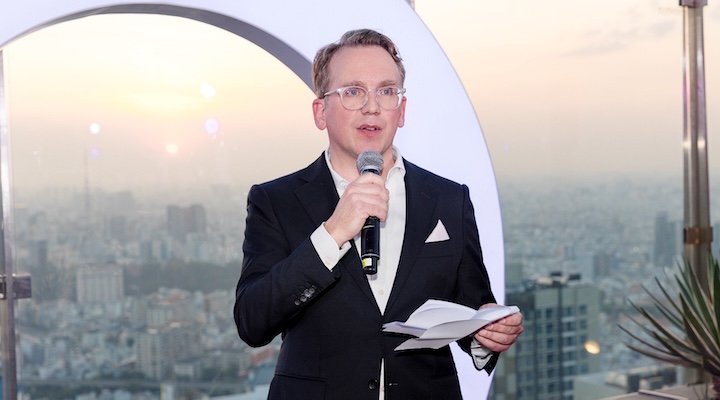

Last month, Pandora Vietnam launched two new seasonal collections for Valentine’s Day and Lunar New Year at its flagship store in Ho Chi Minh’s Landmark 81. The event, attended by local celebrities including Mono and Lam Bao Ngoc, drew heavy foot traffic and highlighted the brand’s increasing visibility among younger, urban consumers. Speaking at the launch, Anders Peter Juel Sauerberg, group CEO of Norbreeze Group – Pandora’s distributor in Vietnam for nearly a decade – described th
the market as a key growth engine, citing its young demographics, rising disposable incomes and rapid shift toward digital commerce.
The launch offered a snapshot of how Pandora is positioning itself to capture demand in one of Southeast Asia’s fastest-evolving consumer markets.
In this interview with Inside Retail, Sauerberg reflects on how Pandora is scaling responsibly in Vietnam, the role of AI and social commerce, and what it takes to build a consistent premium retail experience in a fast-changing market.
Inside Retail: Could you give us some context on Pandora’s operations in Vietnam today?
Anders Peter Juel Sauerberg: Vietnam is among the most exciting growth markets in the region for premium retail, and we see a significant long-term opportunity here. We currently have 20 stores, with two more being built in Can Tho. That will bring us to five cities across Vietnam, which gives us a strong starting platform.
The core of our strategy is simple: Culturally relevant storytelling, disciplined retail execution, and a strong team – consistently delivered at scale. We are also scaling smartly by using AI to better understand customers, improve service consistency and make training more targeted. This allows us to raise performance quickly while building skills responsibly. That is very important to our growth in Vietnam.
Any successful retail company, and any successful company in general, focuses on three things: A strong strategy, a strong team, and strong execution.
IR: The brand has been here for almost 10 years, since 2016. What have been the most significant developments you’ve seen over that time?
AS: Over the past 10 years, the economy has grown considerably. Consumer tastes have evolved, spending patterns have evolved, and people are travelling more. Consumers are drawing inspiration from abroad and demanding better service and brands.
From a macroeconomic perspective, there has been huge development over the last decade. At the same time, consumers have become more sophisticated, which means we also need to improve how we provide service.
There are more malls today, and we can reach customers in very different ways compared with 10 years ago, both online and offline.
With the administrative changes last year, moving from 64 provinces to 32, we also expect further economic activity that will benefit consumers through higher incomes. Looking ahead over the next 10 years, we see very strong opportunities in Vietnam.
Overall, it’s a very different market today, both online and offline, than it was a decade ago. We’ve had to adapt every year. Hiring has become easier in some ways, but competition for talent has increased. It’s a more competitive environment overall.
IR: This also connects to my earlier question. Can you elaborate on the most notable shifts in customer demand since Pandora entered Vietnam?
AS: One of the biggest shifts has been from first-time gifting occasions to more frequent self-purchasing and collecting behaviour. Customers now better understand Pandora’s concept of personalisation and its universe.
Pandora is about giving a voice to people’s lives. You collect milestones and memories and put them on your bracelet – it becomes yours, like a chain of memories from the past, present and future.
We’ve seen a shift from pure gifting to self-purchasing and collecting charms. We’ve also seen a younger, digitally native customer who buys jewellery for identity and self-expression, not only for traditional gifting occasions.
If we connect this to what has changed over the past 10 years, online is a big part of that. Ten years ago, it was very difficult to sell jewellery online to the same extent as today.
Vietnam now has a digitally savvy younger population that is comfortable buying online. Platforms like TikTok, Shopee, Zalo, Facebook and Instagram – combined with global exposure – have changed behaviour significantly.
Expectations have risen quickly, especially around service quality and availability. Consumers expect fast delivery, often within one or two days.
Vietnam is also a mobile-first market, with very high mobile penetration. That’s one of the reasons we use AI. It helps us learn faster from consumer behaviour and turn insights into better service standards and more targeted training.
We can see age groups, gender, movement within stores, what customers are looking at, and how our staff engage with them. Data is safeguarded – we analyse patterns of behaviour, not individuals. We can also assess how quickly customers are served and where opportunities are missed.
This level of insight simply wasn’t possible 10 years ago.
Consumer behaviour also varies significantly between cities – Hanoi, Ho Chi Minh City, Can Tho, Da Nang – so local adaptation is critical.
IR: Can you talk about your TikTok strategy and how it’s performing?
AS: We began TikTok livestreaming last year, and it has grown incredibly fast. TikTok and Shopee have gone from contributing nothing to becoming a significant part of our online sales.
We connect with customers wherever it’s most convenient for them – on their phones, at home, or on the go. We operate a dedicated livestream studio, and some of our best storytellers host these sessions. It’s not just about sales; it’s also about learning how to communicate consistently across channels, whether in-store, online, or via customer service.
While I won’t share specific numbers, TikTok has grown into a meaningful share of our e-commerce business, and we are increasingly ambitious about scaling our presence there. We expect this channel to grow at a high rate year-on-year, potentially faster than physical retail.
IR: Do you see any risks in using TikTok as a sales platform, especially around brand image and over-promotion?
AS: That’s a very valid concern. We’re extremely conscious of pricing, discounting, and brand equity. TikTok is a channel that must be managed carefully to ensure it complements, not cannibalises, our physical stores. We control which SKUs appear on which platforms.
TikTok is also an important customer acquisition tool, particularly for Gen Z consumers who may not initially visit physical stores. Used thoughtfully, it allows us to introduce the brand in new ways and bring customers into our ecosystem, who then engage with us across channels over time.
And brand equity is something we protect very carefully. TikTok is simply another channel – but one that requires far greater discipline in pricing, storytelling, and brand presentation. Our bracelet remains the key entry point. It introduces customers to the brand online, while charms are often purchased in-store later. If managed well, this creates a virtuous cycle rather than cannibalisation.
IR: Is growth in Vietnam currently driven more by new customer acquisition or by repeat customers?
AS: Vietnam is very clearly a two-engine market for us. Customer acquisition remains critical given the population’s sheer size and demographics: Nearly 100 million people, with around 70 per cent under the age of 35.
At the same time, Pandora’s model is built around lifetime value through collecting, stacking, and gifting cycles. We focus on recruiting new customers while strengthening loyalty through service quality and compelling collecting journeys. Both acquisition and retention are equally important for sustainable growth.
Pandora is also uniquely multi-generational. We often see four generations of women engaging with the brand, from young girls to grandmothers.
We target both psychographic and demographic segments. While Gen Z is currently a strong focus, older customers are equally important and buy different products for different reasons. Ultimately, Pandora is about giving a voice to people’s lives, and that resonates across generations.
IR: What does a successful Pandora store in Vietnam look like operationally?
AS: From a commercial perspective, it’s about consistency, productivity, and brand execution. We focus on fundamentals such as traffic, conversion, basket composition, CRM metrics, loyalty, and new customer mix.
But beyond metrics, a successful store brings joy. It helps customers express themselves and tell their personal stories. We are not an off-the-shelf brand – we’re part of people’s lives, and that emotional connection is what truly differentiates Pandora in Vietnam.
IR: What operational challenges in Vietnam do global brands often underestimate?
AS: Vietnam offers enormous upside, but it also rewards strong execution and punishes inconsistency very quickly.
Talent stability is critical. Service quality, training, and retention are major drivers of success, yet retail labour can be volatile. Without a strong team, consistent execution is impossible.
Brands also underestimate how quickly issues can escalate through social media. A single poor in-store experience can become a brand-level problem. That’s why transparency, training and internal communication are essential.
IR: Looking ahead, what will determine Pandora’s next phase of growth in Vietnam?
AS: Expansion into additional cities like Da Nang and Can Tho is part of the plan, but growth is ultimately about getting closer to customers – both online and offline.
We use data to understand where customers are engaging with us and adapt accordingly. The next phase will be driven by deeper engagement with existing customers, continued acquisition, and consistent execution.
Consumers today expect more than transactions – they want experiences. If we stay relevant, disciplined, and customer-obsessed, Vietnam will remain one of Pandora’s most compelling growth markets in Southeast Asia.
Further reading: Pandora’s Luciano Rodembusch on the importance of emotional connection in retail.


