
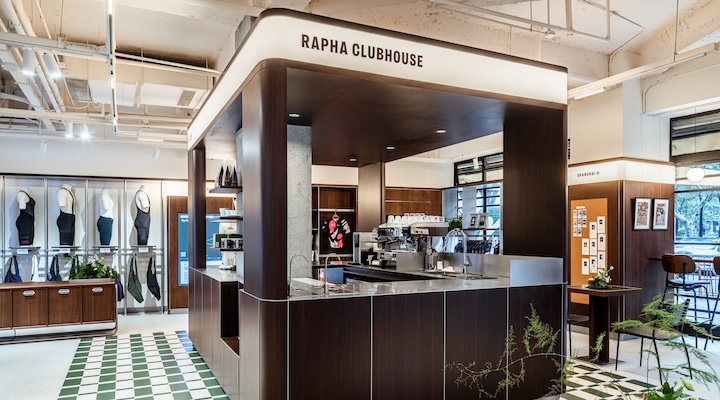
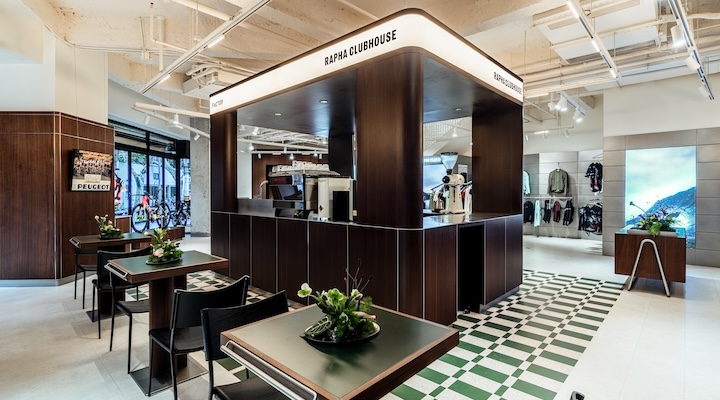

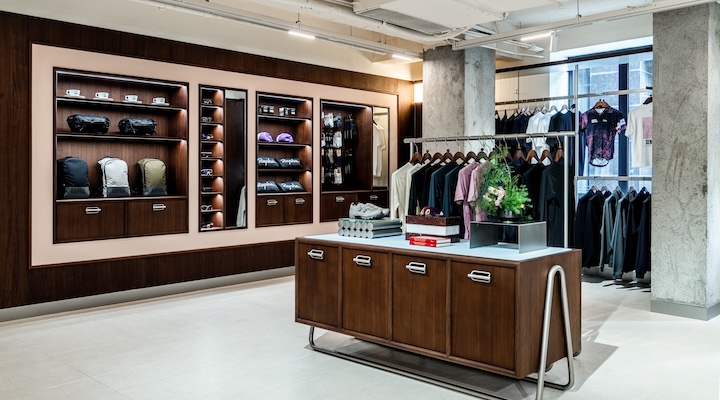
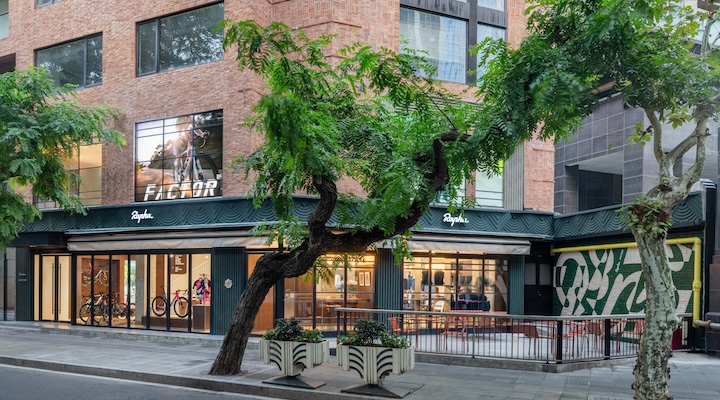
Shanghai is the first expression of Rapha’s redesigned Clubhouse vision, drawing on the elegance of Italian cafe culture and reinterpreting it as a contemporary meeting point for the local cycling community. Set within a restored 1925 mansion, the space honours the building’s heritage while hinting at a new plan for Rapha in China. Strictly following the Clubhouse identity, the interior brings together British industrial design principles and mid-century modern influences, realised through m
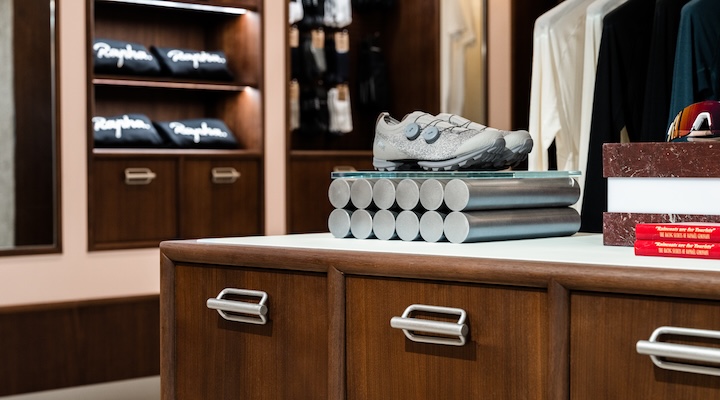
h materials such as walnut, stainless steel, white oak and ceramic tiling, with the brand’s subtle pink accents woven throughout.
The result is a space that balances warmth and functionality, with details such as helmet hooks, adaptable layouts and Roubaix-inspired tile patterns designed specifically around the needs and rhythms of cyclists.
Inside Retail speaks with Alex Edwards, design director at Seen Studios, about the thinking behind Rapha’s next-generation Clubhouse concept. In this conversation, he discusses the design philosophies that guided the project, the practical challenges of creating a multifunctional space, and how lessons from the Shanghai Clubhouse might influence the future of experience-led environments for lifestyle and performance brands.
Inside Retail: Alex Edwards referenced the “next-generation Clubhouse concept”. How does the Shanghai design represent an evolution from previous Clubhouse designs, and what key new elements or philosophies were introduced?
Alex Edwards: During the extensive research phase of the project, Rapha spoke about how the ‘golden age of cycling’ in the 1950s and the Giro d’Italia were both key influences for the brand’s conception. We delved into the design aesthetics these embodied and found a natural, cohesive overlap between the two: warm, welcoming places where people can slow down, form genuine connections, and feel part of a wider community.
This became a natural starting point for the development of the next generation of the Clubhouse concept. Deeper than aesthetics, we want cyclists to intuitively feel and understand the deep-rooted heritage Rapha has within the cycling community the moment they enter the Clubhouse.
IR: Could you provide further detail on the integration of British industrial design, mid-century modern lens, and subtle pink accents? How do these elements collectively convey Rapha’s brand identity while creating a “home for the cycling community?
AE: British industrial design creates the foundation by putting honest materials, functional detailing and British making culture at its core. These design principles mirror the art of bike design and naturally become central to our design approach. We aimed to avoid overt ‘bike’ references and instead drew on the craftsmanship and precision inherent in their forms.
The mid-century modern influence then softens this foundation with warmth, balance and simplicity. Clean lines, considered proportions, and human-scaled spaces help create an environment that feels approachable and timeless rather than overly technical. This aligns with Rapha’s blend of performance and community; elevated yet familiar.
The subtle pink accents act as a gentle brand signature. Rather than dominating the space, these touches provide a quiet nod to both Rapha’s visual language and the colours widely used in mid-century palettes, with pastel colours complementing rich timber tones. It adds vibrancy and brand recognition without being overwhelming.
It’s no coincidence that these influences were, and still are, so familiar in residential architecture, given that the core of our brief was to create a home for the cycling community.
IR: What were the biggest design challenges in creating a space that seamlessly blends retail, café, and event functionality for the cycling community (e.g., specific needs like helmet hooks, as mentioned)?
One of the key challenges was creating a space that feels seamless while supporting three different functions, retail, café and events, each with its own needs. Retail demands clear product storytelling and flexible displays, the café requires comfort and a sense of pause, and events call for adaptable, open areas that can shift throughout the day.
For the cycling community, there were also practical needs to address: bike storage, along with all the other accessories and equipment a cyclist might bring pre- or post-ride, and space to gather before or after rides. The challenge was to integrate these without making the space feel cluttered by creating a clear flow and direction through the space.
Our approach was to design a fluid layout with adaptable furniture and subtle zoning that shifts in mood while staying consistent in language, allowing the space to function naturally as a shop, café, and community hub.
IR: What lessons from the Rapha project will influence how you design future spaces for lifestyle or performance brands?
The Rapha project reinforced several lessons that will continue to shape how we design for lifestyle and performance brands. Firstly, how essential grounding spaces in authentic brand heritage is, using materiality, storytelling and atmosphere to create an emotional response rather than relying on literal references. Secondly, the value of designing with flexibility in mind; brands today need spaces that can shift effortlessly between retail, community and experiential functions. And finally, the project highlighted how small and user-focused details can make a cyclist (or performance consumer) feel truly understood by a brand and elevate the overall experience.
Together, these lessons remind us that successful environments for lifestyle and performance brands are those that balance authentic brand identity, adaptability and genuine user wants and needs.
Further reading: Beyond The Vines founder on what’s next for the brand’s second decade.