
“Learning from yesterday to make tomorrow better.”
That was the overriding message delivered on day one of Retail’s Big Show, the National Retail Federation’s (NRF) annual conference and expo, held in New York City this week.
Running from January 11 to 13, the conference drew 40,000 global retail executives and other industry professionals, including suppliers and media, all eager to learn more about the latest trends in shopping and consumer behaviour.
Retail’s top leaders, including Elizabeth Preis, Victoria’s Secret’s chief marketing officer, and Shane Grenley, Mango’s international retail director, dispensed advice on how brands can continually educate themselves to better scale growth globally.
Experts face off: Debating solutions to tomorrow’s retail struggles
The day began with a debate panel, moderated by Retail Creative and Consulting Agency (RCCA)’s Christine Russo, featuring two retail analysts: TD Cowen’s Oliver Chen and SW Retail Advisors’ Stacey Widlitz.
One question Russo asked the panellists – one that has been on many retailers’ minds over the past few years – concerned the actual importance of AI implementation.
Can you get away without fully embracing AI, or will resisting this technology lead to your business’s downfall?
Despite having different perspectives, both Chen and Widlitz agreed that adopting AI is no longer optional but an inevitable reality for retailers today.
From a cost-cutting perspective alone, Chen noted that big-box retailers like Walmart have saved 50 per cent on delivery costs by integrating AI-powered technology into their operations.
What will be important for retailers in the year ahead is to focus on collecting customer data – through tactics like loyalty programs – to optimise AI’s ability to understand customer desires.
“The oil of AI is customer interactions,” Chen stated.
However, as Widlitz pointed out, smaller companies don’t have the same budget flexibility to experiment with AI as bigger players do.
Even larger companies, like Target, cannot benefit from AI integration without properly examining their own friction points.
Brands, big or small, need to determine their top operational friction points – from store layout to supply chain – and ensure their data is clean before factoring AI into the equation.
Building bold global brands in 2026: Strategy, scale and staying power
What does it take to grow and win on the global stage in 2026?
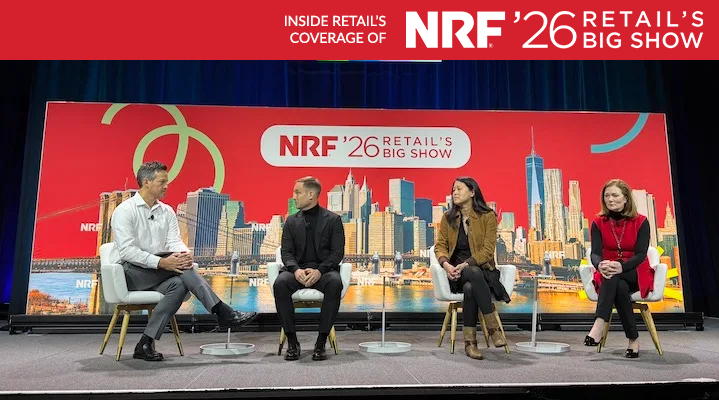
That was the question Vic Drabicky, January Digital’s CEO, asked the panel’s guest speakers, including Elizabeth Preis, Victoria’s Secret’s chief marketing officer; Jennifer Yue, Tapestry’s senior vice president of consumer insights; and Shane Grenley, Mango’s international retail director.
Despite leading teams across different product categories, the panellists agreed on two key points: the importance of determining exactly who your customer is and figuring out the best way to communicate your brand’s values and messaging consistently.
Much like Widlitz emphasised the importance of identifying a company’s friction points before moving forward with innovation, executives like Yue and Grenley noted the significance of stepping back to assess the business’s past and present before planning for the future.
In the case of Mango, a Spanish apparel retailer executing an ambitious multi-year expansion plan, Grenley noted that the brand’s growth – including opening 50 stores in the US in the past 18 months – could not have been accomplished without a clear understanding of its customer.
From collecting customer feedback in stores to walking through malls to observe and understand how customers shop, it is crucial to identify which products are relevant to shoppers and the best ways to showcase those goods.
“It is important to get constant reinforcement from the customer, understand their experiences, and, most importantly, learn from yesterday to make tomorrow better.”
In alignment with Grenley’s perspective, Tapestry’s Yue noted that Coach’s transformational shift in recent years also came from examining past mistakes.
Yue recalled, “It was around the beginning of Covid that we realised we were trying to talk to everyone, and because of it, we weren’t really talking to anyone.”
Recognising that by 2025, 70 per cent of the premium retail market would be generated by Gen Z and millennial consumers—and knowing that most of those consumers weren’t looking at Coach—the team decided to pivot and dive headfirst into research.
Or should we say, home-first?
Yue stated, “That’s when we started spending time across the globe in people’s homes for two to three hours at a time – literally asking them questions not just about their shopping experiences and the brands they’re interested in, but about their hopes, dreams, and challenges in life.”
She noted that even Coach CEO Todd Kahn and Tapestry CEO Joanne Crevoiserat visited customers’ homes in places like Wuxi, China, to understand how their customers lived, which ultimately helped the brands figure out how to pivot and refocus their messaging and product offerings.
“That was how we were able to understand what their lives were like and how we could fit into them.”
By deeply understanding customers’ lives and aspirations, brands like Coach and Mango are better equipped to adapt, innovate and thrive in an ever-evolving global retail landscape.
Ascending together: Driving growth, community and innovation at REI
One of the final panels of the day focused on a brand in the midst of reinvention: American outdoor goods retailer REI Co-op.
In the session, Fast Company executive editor Amy Farley spoke with Mary Beth Laughton, REI’s president and CEO, about the co-op’s new strategic plan, Peak 28: Ascending Together.
“That name was actually really intentional because we wanted to signal to the organisation about our three-year plan of priorities through 2028, but also about accomplishing it together as a team and with our customers.”
Laughton explained that while the brand is focused on strategic pillars such as elevating the customer experience and reinventing its membership program, she is also concerned with ensuring the team moves forward as a collective while preserving the brand’s heritage.
“We realised that we could have this great plan on paper and that the strategy is really solid, but if we didn’t get the cultural evolution at the same time, the plan probably wouldn’t come to fruition.”
For Laughton, executing REI’s cultural evolution involves simple gestures, such as keeping certain holiday traditions alive and taking accountability when mistakes are made.
The CEO recalled that REI issued an apology in January 2025 for endorsing conservative politician Doug Burgum as President Donald Trump’s pick for Interior Secretary.
Laughton, who joined REI in February 2025, officially retracted and apologised for the company’s statement in April 2025, citing the Trump administration’s actions on public lands as conflicting with REI’s values.
“While I do think people were still upset with the Co-op’s decision, I think they appreciated the transparency of the apology. It’s a great lesson on how companies will never be perfect, and sometimes just apologising and showing vulnerability is really helpful [in connecting with consumers].”
Whether it’s engaging with customers – literally and figuratively – to understand their needs or taking accountability for past missteps, day one of NRF showcased the importance of connecting with customers on a considerate and authentic level and the vital role of learning from the past to shape a better future.


